
Conveniently located to serve Los Angeles
At Nu Vela Laser and Vein Center, we offer effective treatments for a variety of vein conditions including reticular veins. Our medical director, Dr. Raffi Dishakjian, is an expert phlebologist who has provided numerous people with outstanding care and results.
Reticular Veins at a Glance
- Size: larger than spider veins but smaller than varicose veins, approximately 1-3 mm in diameter.
- Appearance: dilated blue and green veins beneath the skin surface, usually flat and less tortuous than bulging varicose veins.
- Where: most often the outer thighs and the backs of the thighs and knees, and occasionally the face and chest.
- Also known as: feeder veins, because refluxing reticular veins can give rise to surface spider veins.
- Treatment: sclerotherapy for chest and leg reticular veins, often in several sessions spread over a few months for the legs, and laser treatment for under-eye reticular veins.
- Care at Nu Vela: diagnosis and treatment by Raffi Dishakjian, MD, who personally performs all laser and vein procedures.
What are Reticular Veins?
Reticular veins are larger than spider veins but smaller than varicose veins, approximately 1-3 mm in diameter. They are usually flat and less tortuous than bulging varicose veins and appear as dilated blue and green veins beneath the skin surface. Reticular veins are most often noted in the outer thighs, backs of the thighs and knees, and occasionally on the face and chest. These veins can exist independently but can also be the underlying problem that gives rise to surface spider veins. Because spider veins can result from refluxing reticular veins, reticular veins are also known as feeder veins. Removing reticular veins will help eliminate spider veins.
RETICULAR VEIN FORMS
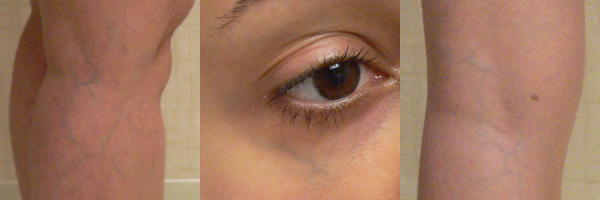
*Individual results may vary.
Treatment of Reticular Veins
Sclerotherapy, which involves the injection of a sclerosing agent through a fine needle, is the most effective treatment for the elimination of chest and leg reticular veins. Leg reticular veins often require several sclerotherapy injection sessions spread over a period of a few months. Although sclerotherapy is sometimes used for the removal of under-eye reticular veins, laser elimination of under eye veins is considered to be safer and gives excellent results.
What to Expect
During your consultation, Dr. Raffi Dishakjian will take the time to carefully examine and properly diagnose your reticular veins in order to determine the best course of action for your treatments. He can answer any questions you may have as well. Our team will also let you know what the expected cost of your reticular vein treatment will be.
Reticular Veins FAQs
How are reticular veins different from spider veins and varicose veins?
Can reticular veins appear on the face or chest?
Do reticular veins cause spider veins?
Which treatments are used for reticular veins?
How many sclerotherapy sessions do leg reticular veins need?
Published Research on Reticular Veins
For symptomatic reticular veins and spider veins of the legs, the 2023 clinical practice guidelines of the Society for Vascular Surgery, the American Venous Forum, and the American Vein and Lymphatic Society (Part II, published in 2024) recommend sclerotherapy, with a liquid or a foam solution.
A 2021 Cochrane review of the treatments for spider veins and reticular veins, covering 35 randomized trials with 3,632 participants, found no evidence that any one sclerosing solution gives a better result than another. The outcome it measured was the resolution or improvement of spider veins.
Sources:
- Gloviczki P, Lawrence PF, Wasan SM, et al. The 2023 Society for Vascular Surgery, American Venous Forum, and American Vein and Lymphatic Society clinical practice guidelines for the management of varicose veins of the lower extremities. Part II. Journal of Vascular Surgery: Venous and Lymphatic Disorders. 2024;12(1):101670.
- Nakano LC, Cacione DG, Baptista-Silva JC, Flumignan RL. Treatment for telangiectasias and reticular veins. Cochrane Database of Systematic Reviews. 2021;10:CD012723.
Contact Us Today
If you are in need of an effective way to treat your reticular veins, contact Nu Vela Laser and Vein Center today to schedule a consultation. Dr. Raffi Dishakjian is a highly skilled and experienced phlebologist who is dedicated to providing our patients with outstanding personalized care.